Hue: This is the precise definition of a colour which is only possible by quoting its mathematical frequency of vibration. Red for instance is a vague term and may be descibed as scarlet, crimson, vermillion or any other derivation. There are many pigment suppliers today and their own brand of cadmium red or cobalt blue is going to differ in subtle ways from others brands. Not only that, but differences will occur even between batches from the same supplier. For the beginner or hobbiest this is not such an issue but for the professional who unavoidably runs out of burnt sienna during a figure painting it can be a big deal. Many suppliers now are also coming out with new hues to which they give names like "Leaf Green". While these suppliers also provide colour charts it is best not to rely on a chart that has been produced using printers inks which can in no way give you a measure of the true colour.
The best idea is to produce your very own colour chart by painting a small dab of the actual colour onto a board for future reference. Label it with the name and manufacturer if you are using more than one brand.
Intensity: This is the purity, brilliance or saturation of a colour. For instance, cadmium yellow is a much more intense pigment than yellow orche which is more intense than raw sienna. For any given hue there is an infinite variation in intensity and this should not be confused with tone.
Tone: The position of a hue on a grey scale between white and black. Think of it this way. If you take a colour image and turn it into a black and white image then that image will be based on the colour's tone only. While not exact it will give you the idea when thinking about a colour's tone. As with our cadmium yellow example, it will be (without mixing) lighter in tone than yellow orche which is lighter in tone than raw sienna.
These three properties are interdependent. Yellow is at maximum intensity in a high (light) tone while violet is at saturation in a low (dark) tone. Colours at maximum intensity conform to a tonal scale as follows: White Yellow Orange Green Red Blue Violet Black.
★★★★☆
This colouring book was a gift for a friend who was travelling to New Zealand. Something to while away the hours on the long flight. It was well received. Bluedaisy - Amazon Review
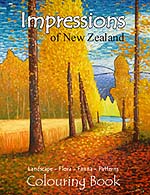
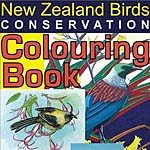
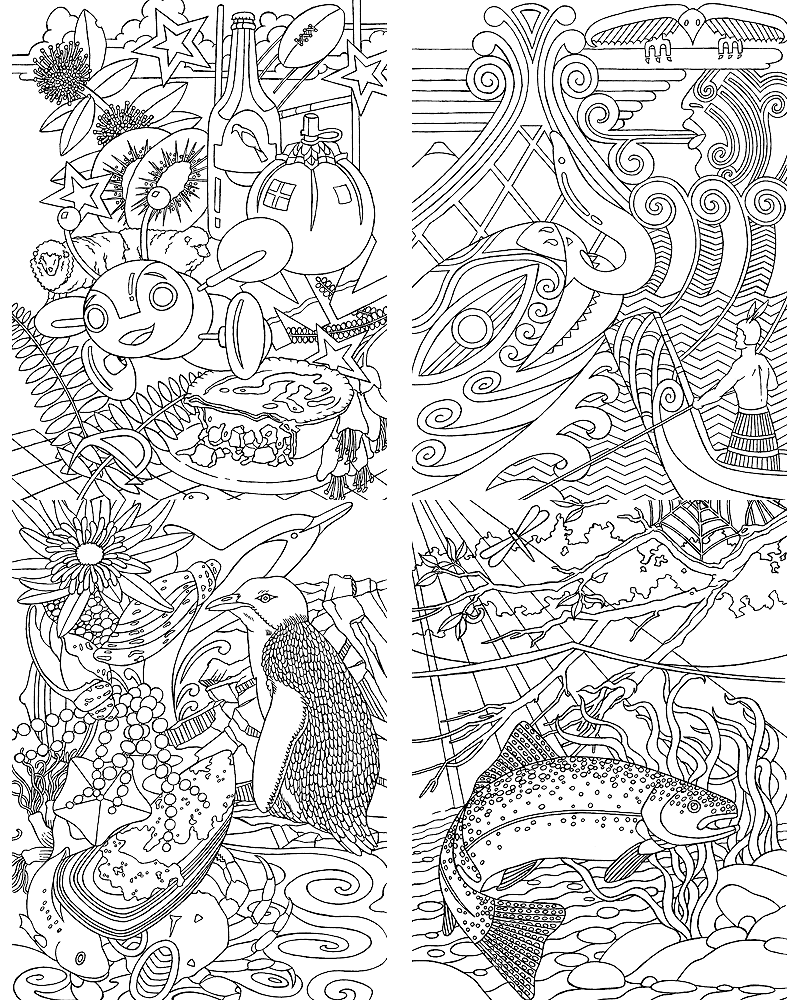
IMPRESSIONS OF NEW ZEALAND COLOURING IN PICTURE BOOK
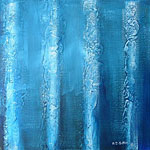
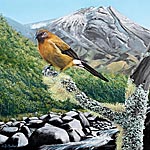
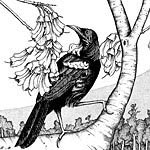
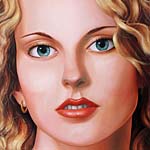
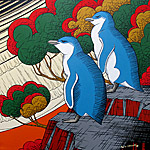
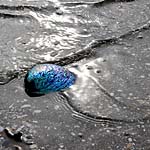
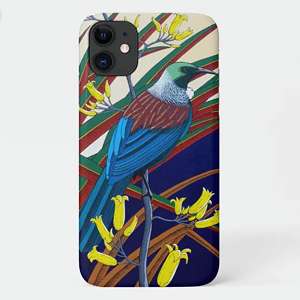
This delightful colouring book features a selection of the landscapes, patterns, flora and fauna of New Zealand. Containing 30 original hand drawn artist images on individual pages that may be removed for framing if desired. Challenge yourself to create an intensely colourful work of art from modern abstract design to realistic reflections and impressions of nature. Suitable for young adult to adult colourists.
Product details: 64 pages
ISBN 978-1523602407
8.5 x 11 inches









 IMPRESSIONS OF NEW ZEALAND COLOURING IN PICTURE BOOK